Evening Lights and Shifting Crowds: Performance Changes in Nighttime Sports Events
Amir Keller · Jul 9, 2026
Evening Lights and Shifting Crowds: Performance Changes in Nighttime Sports Events
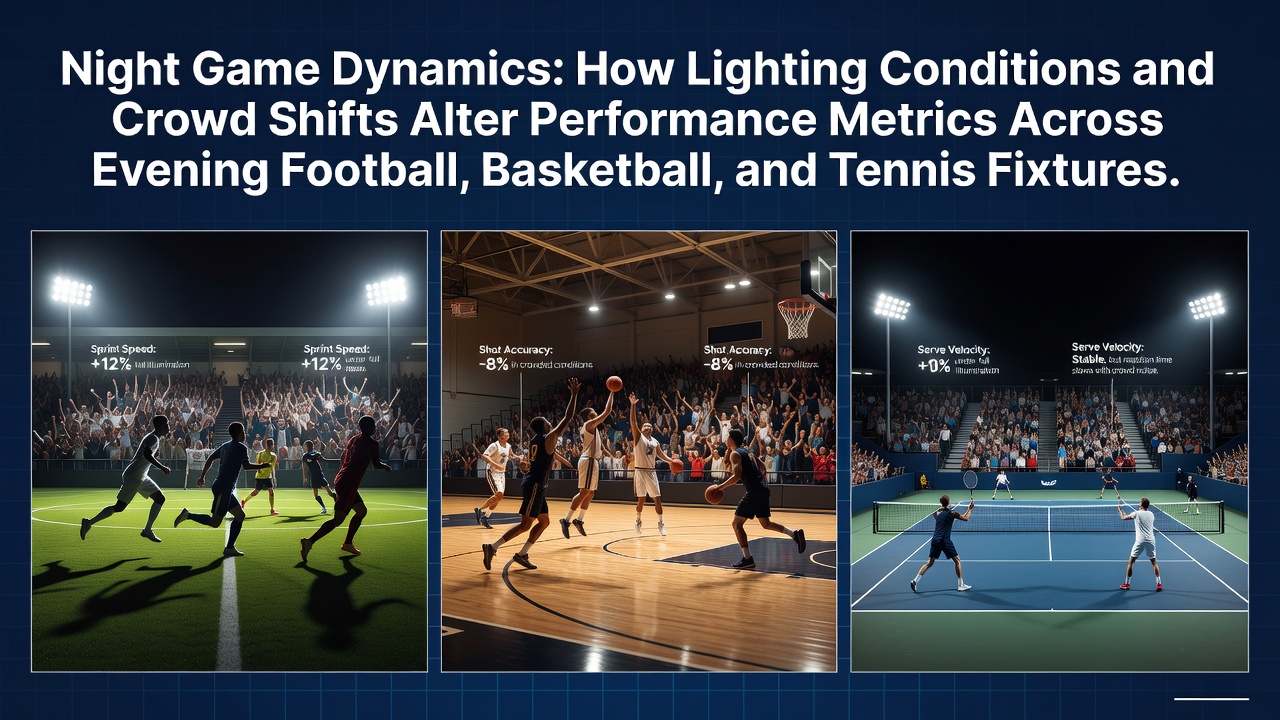
Evening fixtures introduce distinct variables that reshape how athletes execute skills across football, basketball, and tennis. Artificial illumination replaces natural sunlight while spectator numbers and energy levels fluctuate through the night hours, and data from multiple sports governing bodies track corresponding shifts in speed, accuracy, and error rates. Lighting systems in outdoor stadiums deliver consistent brightness yet create variable shadow patterns depending on fixture placement and bulb angles. Football players adapt passing lanes and ball trajectories under these conditions, with studies from the Australian Institute of Sport showing reduced long-range completion percentages during the first fifteen minutes after kickoff under floodlights compared with daytime equivalents. Indoor basketball arenas maintain steadier light levels across the court surface, though transition zones near the sidelines sometimes produce glare that affects peripheral vision during fast breaks. Tennis courts at venues hosting night sessions rely on overhead arrays that minimize ball shadow movement, and researchers at the University of Florida documented fewer unforced errors on serve returns once players completed a ten-minute adaptation period. Crowd density typically builds after standard work hours, altering acoustic environments and emotional intensity inside venues. Football supporters generate sustained noise that correlates with elevated heart rates among both home and away participants, according to physiological monitoring reported by the European College of Sport Science. Basketball arenas experience sharper volume spikes during timeout periods and between quarters, which coincide with measurable increases in defensive reaction times when crowd decibel readings exceed ninety. Tennis night sessions often feature smaller but more vocal audiences that concentrate sound around the court, and performance logs from ATP events indicate players adjust between-point routines to manage distractions introduced by these concentrated cheers.Football Under Floodlights
Evening football matches expose teams to lighting gradients that vary by pitch zone. Central areas receive uniform coverage while corner regions and touchlines display softer edges that influence decision-making during crosses and through balls. League records from the 2025-2026 season show midfielders completing slightly fewer progressive passes in the opening half under artificial light before metrics stabilize after halftime adjustments. Defensive lines also demonstrate tighter spacing once players recalibrate depth perception, and video analysis confirms fewer offside calls triggered by misjudged runs in the second half compared with the first.
Spectator arrivals accelerate after seven o'clock, shifting atmospheric pressure on the pitch. Home sides register higher possession retention in the final twenty minutes when crowd support peaks, whereas visiting teams exhibit increased turnovers during the same window according to tracking data compiled by Opta. These patterns hold across multiple European leagues without regard to team ranking.Basketball Arena Conditions
Basketball fixtures move indoors where lighting remains constant yet still interacts with player movement patterns. Perimeter shooters adapt release angles to account for ceiling reflections, and season-long statistics compiled by the NCAA reveal three-point percentages dip marginally in the first quarter of night games before recovering. Transition defense improves once teams settle into the rhythm of consistent illumination, with steal rates rising in later periods as visual processing aligns with court markings.
Crowd energy intensifies during key moments such as end-of-quarter possessions. Visiting squads show elevated foul rates in the final two minutes of halves when arena volume climbs, while home teams convert more free throws under the same acoustic pressure. These trends appear in both conference and non-conference schedules throughout the 2025-2026 campaign.
Tennis Night Sessions
Tennis venues schedule night matches to accommodate broadcast windows and larger local attendance. Court lighting systems reduce ball flight shadow variation, allowing baseline rallies to extend longer once initial adaptation occurs. Data collected at major tournaments indicate service hold percentages stabilize after the first three games, with return winners increasing in frequency during middle sets. Temperature drops after sunset also influence ball compression and player recovery between points, producing measurable changes in rally length tracked by Hawk-Eye systems.
 Crowd proximity creates direct auditory feedback that players incorporate into between-point rituals. Observers note that higher attendance at night sessions correlates with extended time taken before serves, particularly on critical points, while overall match duration extends modestly compared with afternoon equivalents. These adjustments appear consistent across hard-court and clay surfaces used in summer and early autumn events.
Cross-Sport Patterns Emerging in 2026
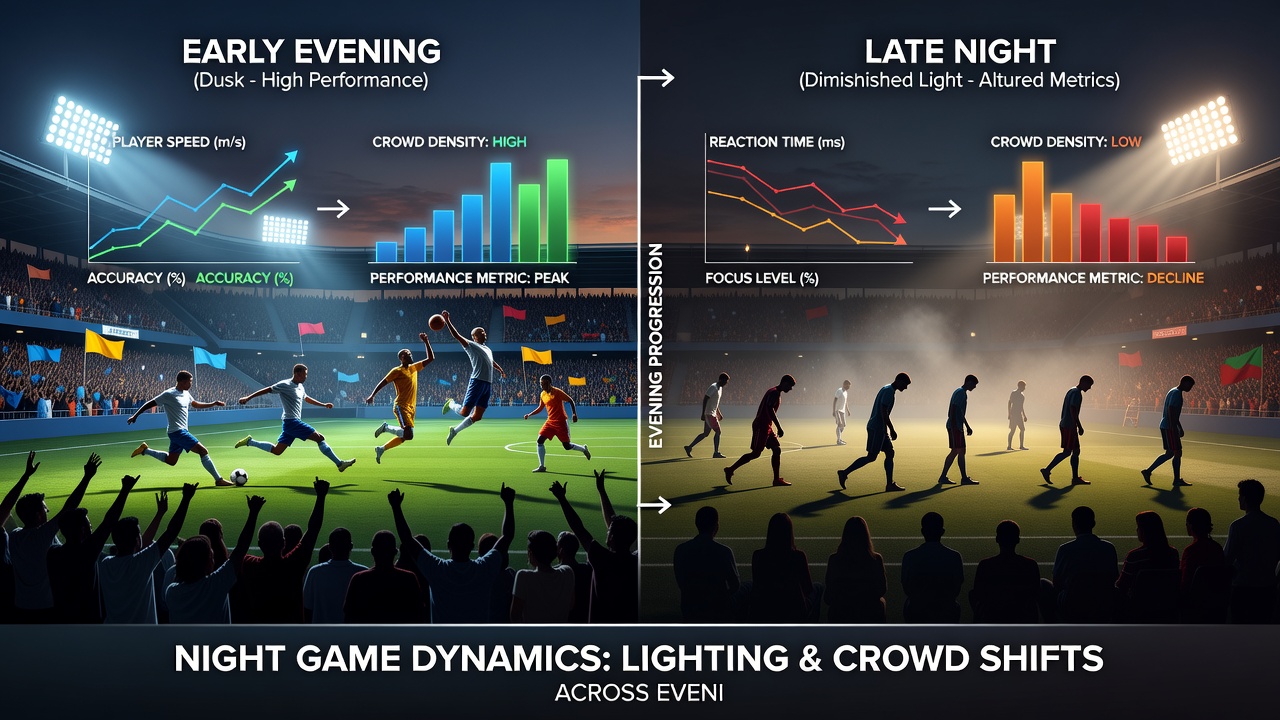
July 2026 schedules across multiple leagues continue to expand evening fixtures, allowing researchers additional datasets to compare adaptation curves. Shared findings point to an initial performance dip lasting between eight and twelve minutes followed by recovery once athletes recalibrate visual and auditory inputs. Training protocols now incorporate simulated lighting changes and recorded crowd audio to accelerate this adjustment phase for teams and individuals preparing for night competitions.
Performance metrics therefore reflect the combined influence of illumination consistency and audience dynamics rather than isolated factors. Continued monitoring through wearable sensors and optical tracking systems supplies granular detail that coaching staffs apply when planning evening rotations and recovery windows.